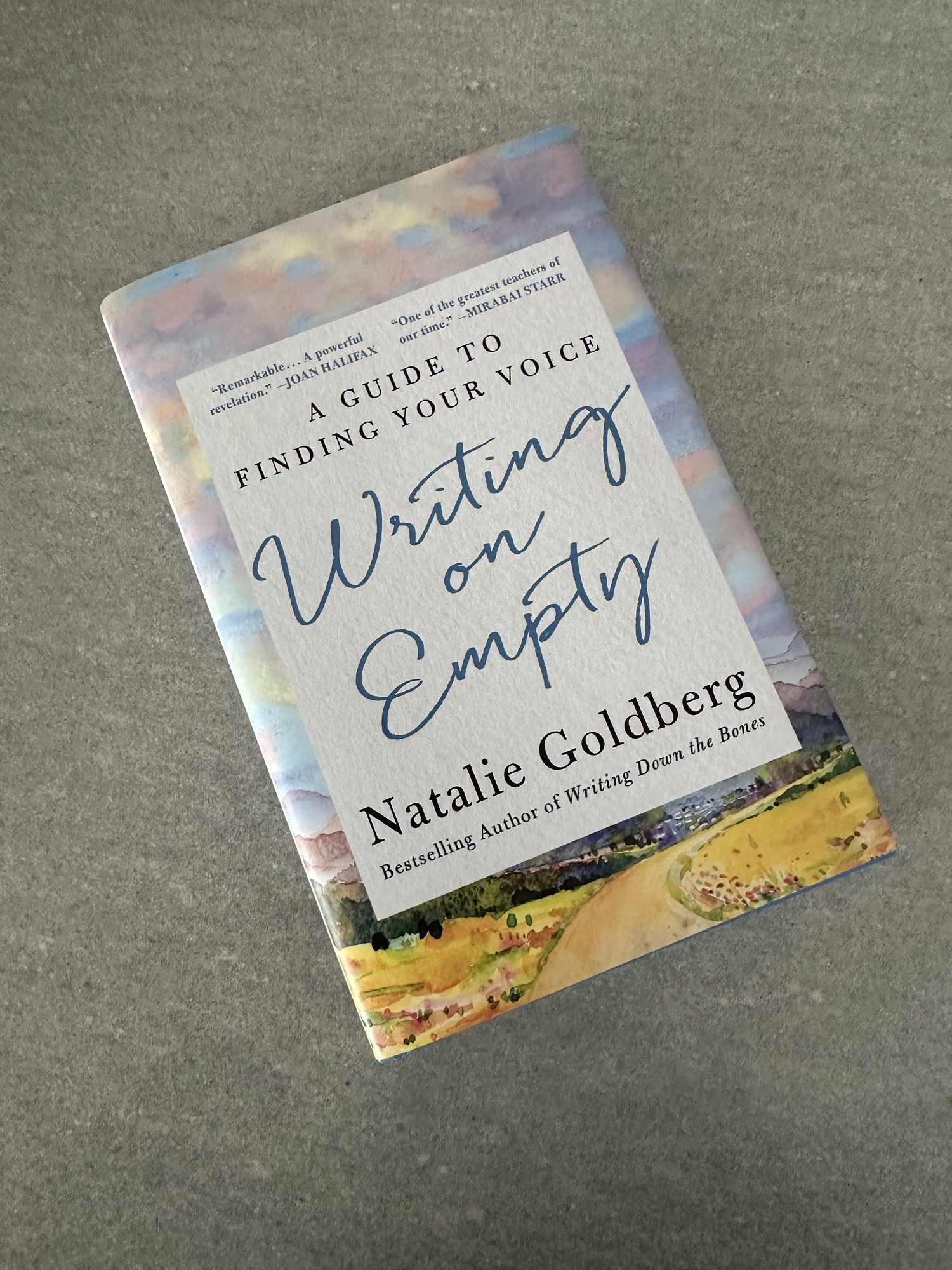
I have a horrible hunger for stories about writers. Whenever I visit a bookstore, one of the sections I feel the need to visit every time is whichever one has the writing books. Even though I used to grow frustrated with biographical information that seemed to get in the way of the writer’s connection to their craft, I have softened over the years to appreciate a lot of these explanations that offer someone like me more to understand. Natalie Goldberg’s most recent work offered all of these things and more in a brief package that lingered with me long after I finished her wandering reflection.
Like many other readers and writers, Writing Down the Bones was one of the first writing books that surfaces whenever I think about books on writing that defined the genre. It has been several years since I first read Goldberg’s book, but her writing practice seen through the lens of her Buddhist worldview lingered with me for years like some of the settings she encourages you to enjoy as ways to expand your modes of thinking. Writing Down the Bones represented a new possibility in what writing books could teach me about what many others claimed to be a fairly straightforward process of getting words down on a page. It only made sense that I had to see what Goldberg could teach me now, especially as she found a way to survive COVID like the rest of us did.
Yet I must acknowledge that all of our COVID experiences were likely different. I know that the first few months of the lockdown experience allowed me to finish both a draft for a book that I was writing and a degree, so I quite enjoyed the opportunity to focus on things that were important to me. As the months continued and so many things remained closed, the situation did become stale. With the start of a new academic year, circumstances changed as quickly as our world did, but I did not mind teaching from home even if it grew harder to reach my students even as my voice and activities reached directly into their homes. Days that normally would have pulled me in several directions now felt streamlined to be able to accomplish as much work as possible from the comfort of home. The interactions that I did have with others were purposeful, and any actions that I could take were meaningful because I had to make an effort to do them when they might otherwise have happened by accident or other circumstance.
Goldberg’s relationship to COVID was much different than my own, even if I recognized similarities in ways of thinking that motivated some of my own choices. The ways she continued meeting with her friend Eddie and exchanging books and other thoughtful gestures reminded me of some of the letters that I wrote to friends during this time when text messages or emails would have been far easier. She discussed how we all reached for that human intimacy during this time that we may not have even had before, but the complete lack of it in any way for those first several months emphasized how much the absence of even the possibility of it occurring meant to us. Our world felt empty and abandoned in places that should have been full of life; life was not the enemy, of course, but gathering together posed too many risks that we did not yet understand. These risks were never far from her narrative just as they were never far from our daily actions.
Goldberg always digs deeply into the subjects she explores, and although I was frustrated at first at the wide paths she took to explore some of her own feelings during this time, I understood later that these detours were necessary for us to understand her reasonings. Viruses may not follow the same rules we do, even if we must find a way to work with, alongside, and against them, but what proved to be more inscrutable as the crisis continued were the actions others took. Our local governments and workplaces made relatively small requests to try to return even the barest amount of normalcy to our lives, yet those appeals to common sense instead inspired so much anger, rebellion, and malevolence that I viewed many people I had known previously through a different lens. Even though these changes are easy to reflect and remark upon now, situations were not moving as quickly then unless they did so negatively. So much was up for reinterpretation during COVID, everything about the world and our place in it.
I even found myself up for reinterpretation, too.
Some of us may have descended into dark echo chambers where our voices reverberated back to us until what was left of our sanity shattered. We all survived COVID with at least a few cracks in our personalities, and Goldberg illustrated how she tried to keep those cracks from burrowing deeper by offering some of her experiences during her writing retreat that helped her forge some of her thoughts together instead of allowing those ideas to wither away into despair. Even now I find myself tempted every week by the possibility of fleeing away to some quiet corner of the world, even if I could only do so for a few days, to write myself to an ending that would bring me happiness. Even though I already spend a great deal of my time alone, a particular magic emerges when I go to an unfamiliar place and try to accomplish the same tasks that I am more than capable of doing elsewhere. Ideas cohere in ways that would never present themselves to me when I occupy my usual haunts. Other writers mention this advice as writing in a new place, but one of the things that struck me as so true with Goldberg’s effort to do so was the fact that she was returning to a place that she had ventured previously and found success. For many of us during COVID, that option was not possible unless we went alone or with others that we found ourselves around all the time anyway, which would defeat the purpose of removing ourselves from our regular environments. I had no trouble writing during COVID, and I do not make this comment to brag; what I instead realized somewhat belatedly—like Goldberg herself remarks—was that much of what I produced during that time was not the quality I was seeking. The words fulfilled a need during that time, yes, but my phrases and sentences did not build a story that I needed to tell. I told a story that I wanted to tell while I never took the time to question whether I was outlining anything other than the fancies of my own soul. I was so enthralled with the fact that I had the time to write that I did not normally have that I lost sight of the story I meant to share with others. Goldberg showed me through her own struggles that getting lost is nothing to be ashamed of, even if we become so lost that we do not even know when we have run aground some time ago. The ship that brought us to this point may no longer be sound enough to take us back to the waters of discovery, though we may be able to engineer ourselves a smaller vessel to attempt the journey once again.

Writers should always be willing to escape into the open waters again even after tragedy. Being able and willing to do so requires a fortitude to put oneself back together, sometimes in multiple ways after multiple collapses, so that we can follow the story where it is willing to take us. If we as writers do not reach some realization through the process of writing, then we did something wrong; the only option left for us is to try to write again and again and again until the story communicates the same beauty we see through our renewed vision of the world. We may rewrite something a few or even a dozen times, yet the most powerful way will always be the way that animates us as much as it may animate our readers. We can recognize that feeling in others’ writing, too, and I always appreciate when I am lucky enough to find examples of such emotional wandering that I feel like I can share with others.
I was not sure that I was going to enjoy Writing on Empty as much as I had enjoyed Goldberg’s other books, but I finished reading it weeks ago and still find some of the images she left with me crowding my mind when I slow myself down enough to think about my own writing. She captured a journey that I myself was too numb to realize I also followed, wading through wreckages of my past and only encountering new debris that I supposed represented my future. Like many other people, my body may have survived COVID more or less intact, but I should have given my own story more thought instead of worrying only about surviving. As the muddied waters of my life rose farther and faster, it never occurred to me that things did not have to continue to fall into despair. Thanks to Goldberg, I now see that I can rearrange those pieces of my surroundings as effortlessly as I can move words in a composition to create something entirely different. Sometimes we need that shift in our lives—a shifting of places, people, or perspectives—to allow ourselves to find our voice—and our desire to speak out—once again.

Leave a Reply