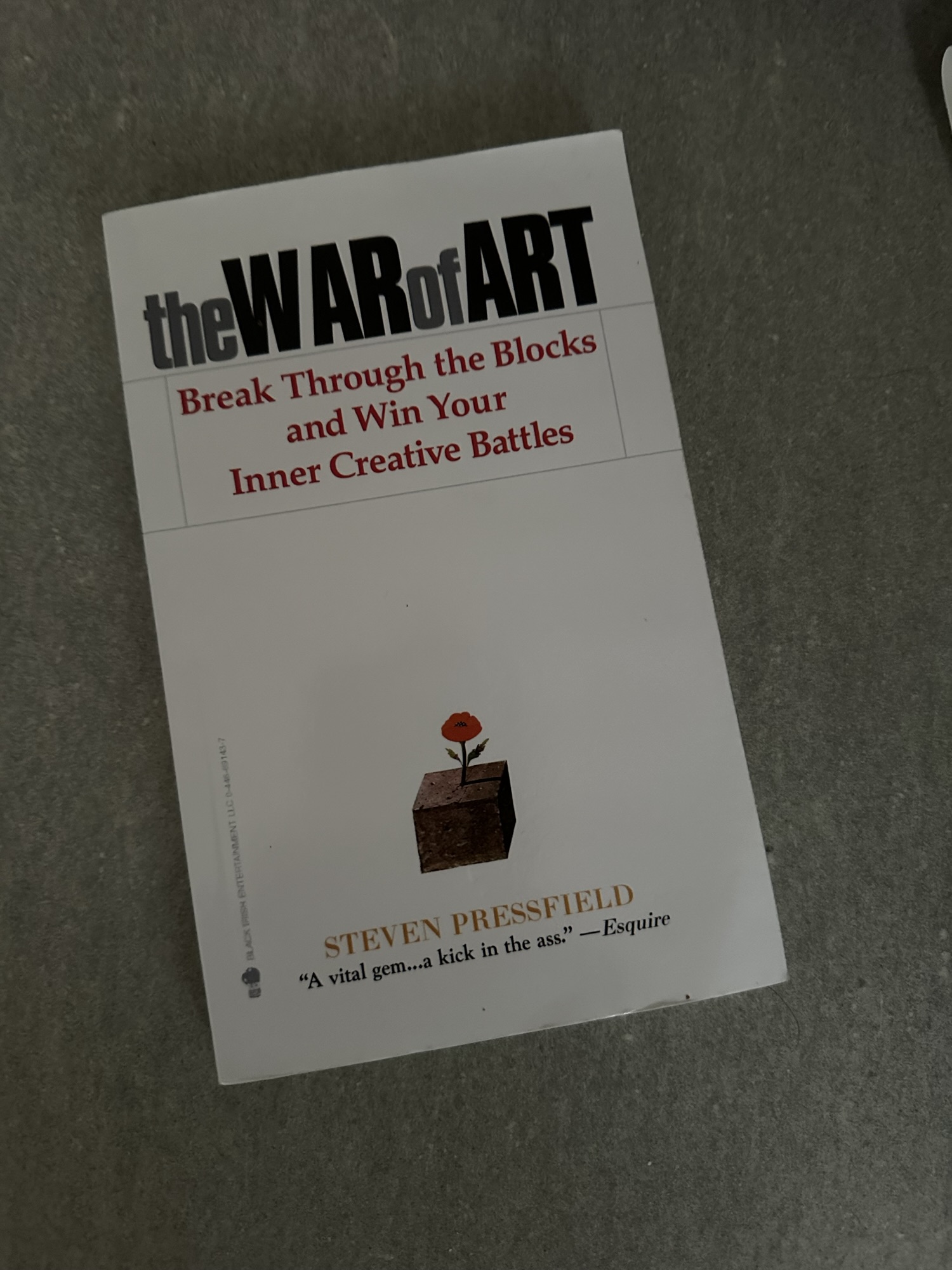
Although I cannot remember where exactly I read the first reference to the book, sometimes allusions to a work of art sound again and again throughout other written works until we must face the original source. That constant reemergence describes my journey to Steven Pressfield’s The War of Art: Break Through the Blocks and Win Your Inner Creative Battles, and I was happy to read a few surprises throughout the work that made me appreciate the simplicity of Pressfield’s idea as I tried to apply it to my own life.
While I do not usually like to describe myself as “easily distracted”, I mostly only do so because others have not described me that way. I also try not to depend on the opinions of others too much for validation when I have more than enough views of myself to confuse myself, but I recognized many of the ways Pressfield described that resistance enters our lives. I try to be more mindful now of those various distractions in order to not give in as easily by looking at the choices that I am making and trying to elaborate upon how those choices serve my creative goals, like he instructs us to do. Such a small effort by itself is enough to get one thinking about all the moves that keep us from being successful! The point, of course, is to learn enough about our own patterns so that we can choose not to take part in the same distraction again the next time we sit down to work, for people like me have found ever more elaborate ways to forgo working on current projects—even by working on other projects or other jobs! Some people have built entire professions around not accomplishing their life’s work, and as long as I can keep myself from doing so, I may be able to convince myself that I have had a successful life of creativity.
I could see why so many artists referenced this work as soon as I reached the meat of his argument. Resistance balances our creative drive sometimes, but more often than not people allow it to overwhelm our urge to create. We are our own worst enemies, it seems, and we may get lost in our own wonder and glee at being close to a subject for a while. Pressfield’s solution to this problem and every other related issue that stems from it is asking the question of whether the action we take serves to further our artistic goals; if the project, diversion, or whatever does not do so, then we should eliminate the action and replace it with work that does expand us as creators. We should grow ever conscious of taking new duties or roles when they conflict with our creative goals, as they might become a source of resistance that inhibits our abilities. This resistance represents the greatest threat to creating our art or creating the conditions we need to create our art.
As deep in the land of education as I am, I am no stranger to excuses. I know we can tailor excuses to fit whichever activity we would rather do than work on our art just as easily as my students relay their excuses for where they have been for the last several days with a calm aloofness. Being a writer or an artist requires a certain amount of honesty with oneself and one’s readers, so we need to learn to realize when we are the ones keeping ourselves from working on our own greatness. We can say that we need to organize our library in order to have a clear workspace in which we can create, knowing deep within ourselves that we do most of our writing on the couch anyway, so an organized library will really not help us to write that short story we have been thinking about writing for months. I will admit that sometimes I do strange things to help prompt ideas, but I will always be honest with myself whenever I am doing an action just to get out of doing something else. I reflect often so that I can realize when I fall into certain patterns with myself; over the last few months I have learned to turn down opportunities that would otherwise steal time from me that I would use to develop my craft. In the past I would have blindly accepted every stray workshop, professional development session, or chance to show my devotion to my field, yet it was Pressfield who showed me that I used these instances to take away from artistic development and thus only debase myself as an artist. I had to learn a word that I had forced myself to forget long ago so that I could try to be the best teacher that I could be: No. Now that I have relearned the word, I examine every use of my time in order to decide whether I should continue to devote time towards that adventure. Whether the expenditure will be an hour during one evening or a month-long commitment, the effort I spend to decide whether it will add more to my life than the time will take away serves as a guiding metric each time.
Saying no has even helped me to relearn how to rest.
Sometimes examining how I spent my time left me unsatisfied with the amount of time I devoted to my craft. I grew sad at other times that I could not go out into the world to take part in events that I wanted to take part in, yet I had to remind myself that I am serious about being a writer enough that I need to work when I know I have the time to do so. I still make sure I have time to see my family, even if I am fine allowing other aspects of my social life to wither and die, but I have discovered that I need to guard my artistic time ever more fiercely as I age. I do not do so out of spite or defense; I do so in order to share the best version of myself with everyone around me. A writing teacher who is not writing may not have much to teach students still learning their way with words, but an instructor who understands the constant struggle to get the words down on the page can not only commiserate with his or her students but also help guide them through the same obstacles that plague us all. Students and teachers both often lose their minds when they ask themselves, “What do I do next?”

In order to answer this question honestly, I needed to learn how I had welcomed resistance into my life, and Pressfield was the one who showed me how sometimes my best efforts to accomplish tasks had, in fact, sapped me of the strength I had hoped to develop by doing the tasks. For writing as a creative art, there is only one way to better oneself at writing—to write. No writer can escape this truth no matter what else they do to try to cover up that fact. When I realized this truth, I began to yearn for the open hours that I could fill with writing, knowing that I had other duties that could steal my time but that I should not spend my time doing anything else. Instead of worrying to make time in a schedule where the time was not always freely available, I found the time after I asked myself that question at the heart of The War of Art. My answer became my ability to sit down without resistance and write again.

Leave a Reply